In Stone Canyon, the Lot Price Is the Least Useful Number You'll See
September 24, 2026
September 24, 2026
Two vacant homesites listed in Stone Canyon this year sat in roughly the same price band and both ran a little over two acres. One sat on a flat building envelope, and the listing said so directly, because flat ground means significantly less site-prep cost before a foundation ever goes in. The other was saguaro-studded and set across from a fairway, with dramatic rock outcroppings that make for a spectacular setting and a materially harder grading job. Same rough price. Same rough acreage. Two very different budgets once you account for what has to happen to the land before you can build on it.
That gap almost never shows up in the number on the flyer. If you are shopping Stone Canyon as raw land rather than a finished home, the purchase price is the beginning of the conversation, not the summary of it. The real cost of building here is decided by three things buried under the listing description: how much site work the terrain demands, whether a private design review process has already been cleared or is still ahead of you, and which of Stone Canyon's seven recorded phases your lot actually sits in.
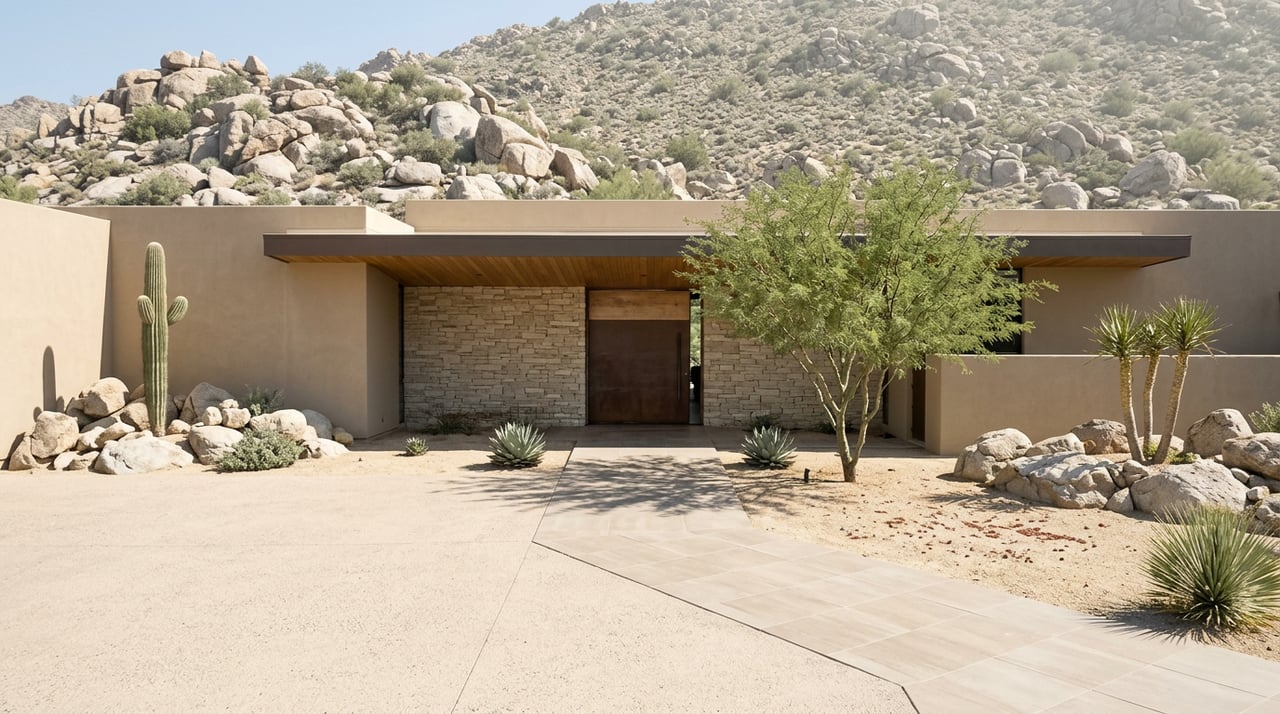
Stone Canyon's marketing language is consistent across nearly every active lot listing: dramatic rock outcroppings, majestic saguaros, boulder-strewn terrain. It is genuinely beautiful land, carved into the Tortolita foothills around a Jay Morrish golf course. It is also land that varies enormously in how expensive it is to prepare.
Some listings specifically call out a flat building envelope as a selling point, explaining that it reduces site-prep costs and gives a buyer more design flexibility because the architect and builder aren't fighting the topography. Others advertise the same boulder outcroppings and saguaro density as the primary amenity, which is a fair way to sell a view lot, but it also means retaining walls, extensive grading, and engineering for the slope before a single wall goes up. Two lots that read almost identically in a listing sheet, similar acreage, similar price point, similar proximity to the club, can require very different construction budgets simply because one is flat and the other isn't.
If you are comparing lots on price per acre alone, you are comparing the wrong number. The site-prep line item is where a seemingly affordable homesite can quietly catch up to, or pass, a pricier one.
Here is where most buyers get surprised. The Town of Oro Valley's own development review process exempts individual detached single-family custom homes from most of its formal review requirements. That is true. It is also incomplete, because it only describes the town's side of the approval chain.
Stone Canyon's recorded CC&Rs establish a separate Design Review Committee that exists independently of the Town of Oro Valley's planning department. This is a private, community-level body written into the governing documents, with its own indemnification provisions for board members and committee volunteers, meaning it functions with real authority over what gets built and how. Skipping the town's review does not mean skipping review. It means the review happens somewhere else, on a different timeline, governed by a different rulebook than the one municipal planning documents describe.
That distinction matters because a buyer who only researches Oro Valley's zoning code will walk away thinking the path to groundbreaking is shorter than it actually is. The town's process and Stone Canyon's private design review are two separate gates, and both have to open before you break ground.
Once you understand that a private design review stands between purchase and construction, a detail that shows up in a handful of lot listings starts to make sense. One Stone Canyon homesite listed this year was marketed with a full set of previously approved plans included in the sale, drawn by architect Mark Soloway. The listing framed this as a way to save considerable expense and hit the ground running.
That framing is accurate, and it is worth taking seriously if you are comparing two otherwise similar lots. A design that has already cleared the community's review process removes one of the biggest variables in a custom build timeline: how long the design review committee takes to approve a submission, and how many revision cycles it takes to get there. A lot with pre-cleared plans is not just land. It is land plus a shortcut through the part of the process that most buyers underestimate. A lot without that head start requires a fresh architect relationship, a fresh set of drawings, and a fresh trip through design review, with no guarantee of a single-pass approval.
When you are weighing price against price, weigh this too. A lot that costs slightly more but comes with an approved plan set may finish faster and cheaper than a lot that costs less but starts the design clock at zero.
Stone Canyon was not built all at once, and its governing rules were not written all at once either. The community is organized into distinct recorded phases, including Stone Canyon I, II, III, IV, VI, VII, and VIII, platted at different points as the development expanded through the Tortolita foothills. Those phases are not interchangeable in what they allow.
The Town of Oro Valley has held a formal neighborhood meeting specifically on a rezoning request to revise the minimum lot size for properties located south of Tortolita Mountain Circle and west of King Air Drive, a specific pocket within the community. That is a direct signal that even something as fundamental as minimum lot size is not fixed community-wide. It has been negotiated and adjusted phase by phase and parcel by parcel as Stone Canyon has grown.
The acreage figure on a listing can also be misleading in a different way. In Stone Canyon's Phase VII, public records around a conditional use request describe roughly 209 acres in the phase's northern section that has been under an active grazing lease since 1987, alongside 200 acres of open space east of a specific parcel that was dedicated to the Town of Oro Valley rather than sold as private lots. Acreage that reads as part of the community on paper is not automatically buildable, privately owned, or free of an existing use. Before you fall in love with a lot's total acreage, it is worth confirming how much of that acreage is actually yours to build on.
None of this is a reason to avoid building in Stone Canyon. It is a reason to ask sharper questions before you commit to a number. If you are seriously considering a homesite here, work through this before you write an offer:
A vacant lot in Stone Canyon is not a commodity. It is a specific parcel, in a specific phase, with a specific relationship to grading costs and design review, and the price alone will not tell you which one you are looking at.
This is exactly the kind of transaction where developer-level experience earns its keep. Knowing which phase a lot belongs to, what its design review history looks like, and what a realistic site-prep budget requires is not something a listing sheet can tell you. It comes from having walked this process before.
If you are weighing a custom build in Stone Canyon, or comparing a finished home against raw land, Suzie Corona brings both a builder's eye and decades of hands-on experience in this specific community to the table. Request a private consultation to talk through the lot, the phase, and the real path to groundbreaking before you make an offer.
Get assistance in determining current property value, crafting a competitive offer, writing and negotiating a contract, and much more. Contact me today.